B2B Website Conversion Optimization: A Proven Framework for Higher Lead Quality
The blog argues B2B conversion optimization should prioritize lead quality over raw traffic and form completions. It offers a practical 10-step framework—researching baselines, defining ICPs and segments, hypothesis-driven tests, prioritization, UX and messaging improvements, form qualification, instrumentation, experiments, human-in-the-loop qualification, and measurement—to boost downstream metrics like MQL-to-SQL and pipeline. Key points include connecting web analytics to CRM, running meaningful tests that affect intent, balancing friction and qualification, aligning CRO with demand gen and Sales, and scaling winning changes. The post closes with quick wins, tools, an ROI approach, a starter checklist, and an offer for a free page audit.
For those running a B2B marketing program, traffic is only half the battle. Traffic is only half the battle – and here’s where things become challenging: converting qualified visitors into qualified leads.
With Whoozit, this gap becomes more visible. In my experience, most teams treat Conversion rate optimization as a silver bullet. They conduct tests, change colors, move buttons around, and count clicks. That might bump up the numbers a little, but it doesn’t generate repeatably meaningful improvements in lead quality, which is exactly what Whoozit was designed to do more strategically.
This post is a practical, step-by-step framework for B2B website conversion optimization. I’ll show you how to improve conversion rates while improving lead quality, not just volume. We’ll combine UX, messaging, analytics, and funnel optimization into one playbook you can apply this quarter.
Why B2B conversion optimization is different
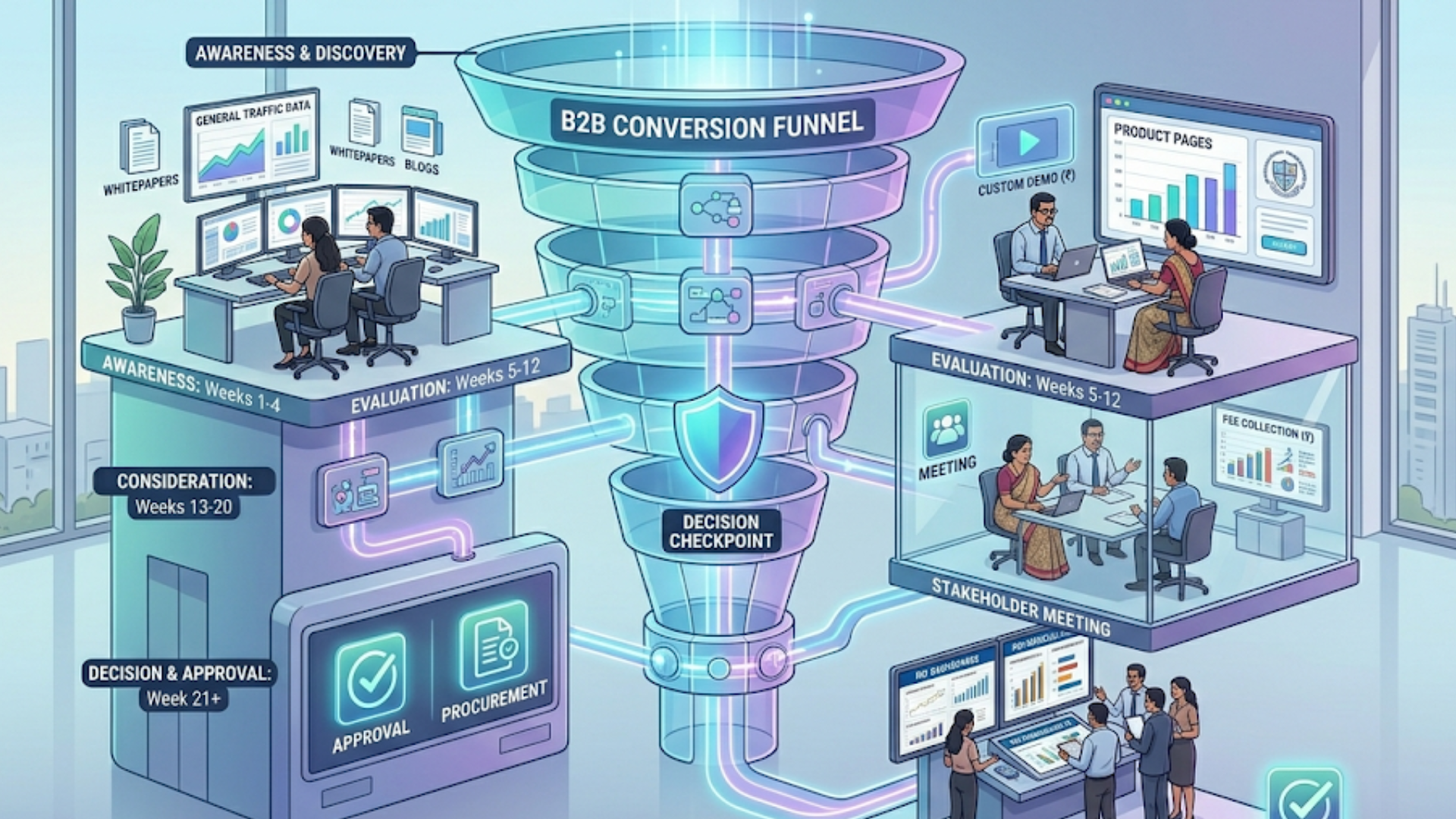
B2B buying is slower, more rational, and often involves several stakeholders. You’re selling to teams, not impulse buyers. That changes the game.
- Decision cycles can last months.
- Multiple people influence the purchase.
- Leads often need education and nurturing, not a fast checkout.
So optimizing your website is not just about increasing form completions. It’s about improving signal quality. Does the lead match your ICP? Are they ready for a sales call? Do they have the budget and authority? If you can answer those questions sooner, your SDRs spend less time chasing unqualified leads. That’s the ROI we want.
The high-level framework
Here’s the framework I use when I audit B2B websites. You can use it as a checklist or a roadmap for a CRO program.
- Research and baseline metrics
- Define target leads and segmentation
- Create hypotheses that increase lead quality
- Prioritize tests using impact-effort scoring
- Design and implement UX and messaging changes
- Instrument analytics and lead scoring
- Run experiments and analyze results
- Scale wins and standardize learnings
It looks linear, but in reality you’ll loop back. You’ll learn from tests, refine the ICP, and iterate on messaging. That’s fine. The important thing is the feedback loop. Ship small bets, measure impact on lead quality, then double down.
Step 1 - Research and baseline metrics
Start with a clear baseline. What are your current conversion rates? What’s the ratio of trials to SQLs? How long does it take for a lead to convert to opportunity? These are the numbers you’ll use to measure improvement.
My favorite first moves are simple and cheap.
- Pull funnel metrics from your analytics and CRM for the last 90 days.
- Segment by traffic source, campaign, and landing page.
- Measure micro-conversions - demo clicks, content downloads, CTA clicks.
- Ask Sales for a list of common objections and disqualifiers.
One trap I see a lot is making decisions on click-through rates alone. Clicks tell you attention. They do not tell you intent. Always connect web analytics to downstream metrics in your CRM. If you can’t do that immediately, at least capture UTM parameters on lead forms so you can join the data later.
Step 2 - Define target leads and segmentation
Before you optimize copy or forms, define who you want to attract. That sounds obvious, but teams often optimize for "more" rather than "better."
Build a simple ICP profile. Don’t overcomplicate it. The basic fields are industry, company size, role/title, pain points, and typical buying motion. If you have a pricing threshold, include that too. This will guide messaging and form questions.
Also segment your pages. Not every visitor should land on the same page. Use targeted landing pages for high-intent campaigns. For example, a paid LinkedIn ad aimed at Head of Security needs different language than a content piece for developers.
Step 3 - Form hypotheses that increase lead quality
Every test should be a hypothesis about lead quality. For B2B websites, common hypotheses fall into three categories: messaging, qualification, and friction.
- Messaging hypothesis - If we clarify the value prop for X, then more qualified users will convert.
- Qualification hypothesis - If we add one targeted question, then fewer unqualified leads will submit forms.
- Friction hypothesis - If we reduce unnecessary fields and improve trust signals, better leads will progress further in the funnel.
Be specific. Instead of saying "make the hero copy better," try "reframe hero copy to talk about time to value for enterprise buyers and include 'SAML support' to attract security-conscious prospects."
Step 4 - Prioritize tests with a simple scoring model
Not every idea deserves equal time. Use a simple impact-effort matrix to prioritize. Estimate the potential impact on qualified leads and how much effort each change requires.
Here’s a quick rubric I use:
- Impact: Reach, conversion lift expected, and downstream effect on SQLs.
- Effort: Engineering time, design, and dependencies like legal review.
- Confidence: Do you have supporting data or user feedback?
High impact, low effort tests are your quick wins. Examples include: tightening headline copy for a vertical, adding a relevant trust badge, or capturing one more qualifying field on a high-intent landing page.
Step 5 - UX and messaging changes that actually move the needle
UX and messaging are the levers most B2B sites neglect. I’ve watched teams pour money into traffic while their homepage still says "we do X" instead of "we solve Y for X." That mismatch kills conversions.
Focus on three parts of every page:
- Hero section - answer “Who is this for?”, “What problem do you solve?”, and “What do I do next?".
- Proof and differentiation - social proof, case studies, competitor comparisons, and data points.
- Action path - clear, low-friction CTAs with contextual options (demo, start free trial, download paper).
Short example. If you’re a SaaS company selling to mid-market HR teams, a hero like this works better: "Stop losing candidates to slow hiring. Automate screening for faster hires. Trusted by 100+ HR teams." Then a CTA: "See it in 10 minutes." It’s specific, benefit-led, and time-bound.
Microcopy matters too. Label fields clearly. Use conversational language on buttons. Instead of "Submit," say "Get a demo" or "See pricing." It increases clarity and reduces friction.
Step 6 - Forms and lead qualification
Forms are where leads are won or lost. But they’re also how you improve lead quality. Ask the right questions at the right time.
Here are practical approaches I've used that work well for B2B:
- Progressive profiling - ask basic info first, then gather details on subsequent interactions.
- Conditional fields - show advanced questions only when they matter, like company size if they select "Enterprise."
- Smart default options - preselect options based on UTMs or referral source.
- Use explicit qualifying questions - "Are you evaluating solutions for your company?" or "Estimated monthly spend on X."
One common pitfall is adding too many mandatory fields early on. That reduces submissions but not necessarily increases lead quality. I recommend a minimal friction initial form and a second-step qualification like a short calendar booking or a quick follow-up survey.
Step 7 - Instrumentation and analytics
If you can’t measure it, you can’t improve it. This is where most programs stumble. Proper instrumentation connects website behavior to CRM outcomes.
- Track all CTA clicks and form submissions with UTMs and event tags.
- Capture lead source and campaign metadata on every lead.
- Send events to your analytics and CDP, then sync to your CRM.
- Set up lead scoring to classify MQLs and SQLs automatically.
Also instrument micro-behaviors. Track whitepaper downloads, pricing page visits, and feature page scroll depth. Those signals often predict sales readiness. In my experience, a pricing page view followed by a product demo request is one of the strongest predictors of intent.
Step 8 - Design experiments and A/B tests that matter
Testing is great when your tests are meaningful. Avoid the temptation to run meaningless color tests for months. For B2B, pick tests that affect understanding and intent.
Priority test ideas:
- Value proposition variants - lead with outcome versus feature set.
- CTA choices - demo vs. trial vs. contact sales, depending on ICP.
- Form flows - single-step vs. two-step qualification.
- Page segmentation - personalized landing page vs. general homepage.
- Pricing presentation - ranges and qualification content vs. hidden prices.
Run tests until they’re conclusive. Use statistical significance but don't obsess over tiny lifts. Look at downstream impact on lead quality: SQL rate, meeting show rate, and pipeline created. Those matter more than a 3 percent increase in form submissions.
Step 9 - Qualify leads with human-in-the-loop processes
Automation helps, but humans still make judgment calls. SDRs should have clear qualification criteria tied to the website signals you collect.
Quick example. If a lead submits a demo request and indicates company size under 50 employees, tag it as Mid-Market. If they say enterprise and request SSO support, route to Enterprise AE. Routing like this speeds time-to-contact and improves conversion from lead to opportunity.
Also, add a short intake question on the demo booking page. A single question like "What is your main goal with X?" will give sellers immediate context for the call.
Step 10 - Measure lead quality and iterate
Conversion rate is nice to track. Lead quality is what drives revenue. So define and track quality metrics.
Core KPIs I use:
- Lead-to-MQL conversion rate
- MQL-to-SQL conversion rate
- SQL-to-Opportunity conversion rate
- Average time from lead to first sales activity
- Pipeline created per 100 leads
- Demo show rate and no-show rate
Run retroactive analyses. For cohorts of leads from landing page A vs page B, compare the downstream conversion rates over 90 days. That tells you which pages are truly delivering quality, not just high volume.
Common mistakes and how to avoid them
I’ve seen the same traps over and over. Here are the top five and how to dodge them.
- Focusing only on top-of-funnel metrics. Always connect web metrics to CRM outcomes.
- Testing too many things at once. Keep hypothesis-driven, isolated tests.
- Changing copy without user research. Validate message changes with quick user interviews or session recordings.
- Not segmenting traffic. Treat paid, organic, and referral traffic differently.
- Ignoring the handoff to Sales. Build processes that route, score, and prioritize leads.
Practical examples and quick wins
Here are a few concrete changes you can make this week. These are low effort and often high impact.
- Replace generic hero claims with outcome-oriented headlines. Example: "Cut onboarding time by 40 percent for distributed teams."
- Add a clear, second CTA for users who are not ready for a demo. Example: "Get the short guide" or "See the 5 minute demo video."
- Show pricing ranges for enterprise versus mid-market. Transparency reduces friction and screens leads.
- Pre-fill company size or industry using IP-based hints to reduce friction and improve qualification.
- Use short testimonials from recognizable customers and include results with numbers. Numbers sell.
One quick case. I worked with a SaaS founder who had a steady flow of demo requests but a low opportunity rate. We added a single qualifying question on the demo booking page about purchase timeline. That one change improved demo-to-opportunity conversion by 18 percent. It cost almost zero to implement, and sales loved it.
Scaling what works
Once a test shows the right impact on lead quality, scale it. Don’t just roll out to the homepage. Apply the change across traffic segments and channel-specific landing pages.
Create playbooks for common use cases. For example:
- Paid search playbook - lean towards conversion-focused CTAs and fewer form fields.
- Content marketing playbook - use content upgrades to capture intent and educate.
- Enterprise playbook - include case studies, security attestations, and an enterprise booking flow.
Document the test, hypothesis, results, and learnings. Keep a central repository. It pays off when new team members join or when you need to explain decisions to leadership.
How UX ties into conversion funnel B2B
UX is not just design. It’s the entire experience from discovery to demo. Small UX improvements often have outsized effects in B2B because the buying process has more steps and more stakeholders.
Key UX improvements that influence conversions:
- Clear information hierarchy. Visitors should instantly know what you do and for whom.
- Consistent CTAs. Don't confuse visitors with multiple competing actions.
- Mobile-first optimization. B2B buyers increasingly research on mobile.
- Accessibility and load performance. Slow pages kill conversions and frustrate buyers.
In my experience, the simplest UX changes are often the most impactful. For instance, moving a case study higher on the page to match the hero claim can improve engagement with that proof point. That leads to higher demo requests from the right companies.
How to combine CRO with B2B marketing optimization
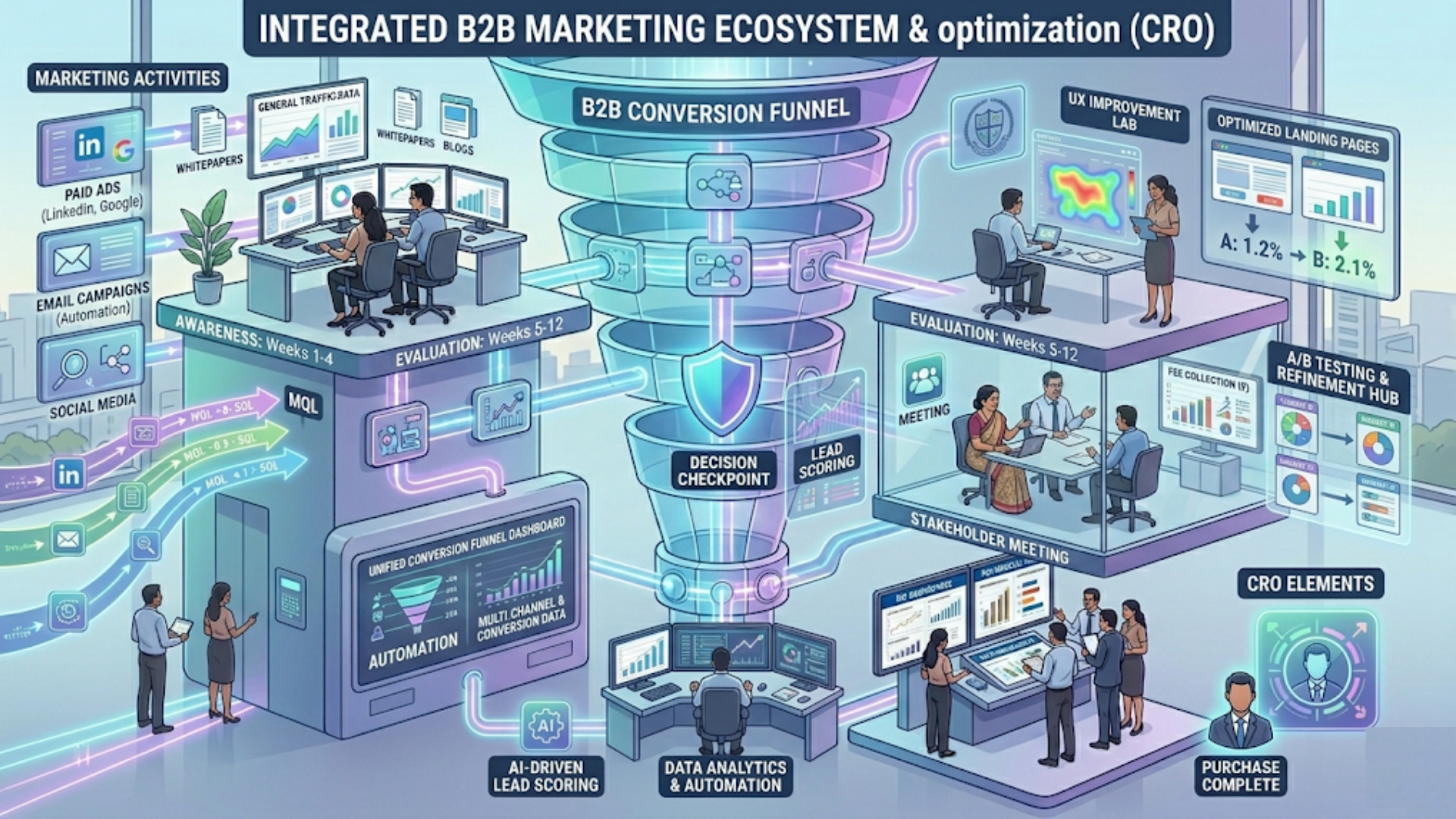
CRO and broader B2B marketing optimization should work together. CRO improves conversion of the traffic you have. Marketing optimization makes that traffic better in the first place.
Coordinate with demand gen teams on targeting and messaging. If demand gen can funnel intent-rich traffic to a page designed for conversion, you’ll see a compounding effect. Align on:
- Which ICP segments to prioritize
- Shared KPIs, like pipeline per 1,000 visits
- Feedback loops where Sales shares which campaigns produce the best leads
One practical tactic: run a targeted paid campaign for a specific vertical and pair it with a matching landing page. Don’t send all traffic to the homepage. That alignment turns clicks into better-quality leads quickly.
Tools and tech that help
You don’t need a huge tech stack to start. But these categories help:
- Analytics - Google Analytics 4, or Mixpanel for event tracking
- Experimentation - Optimizely, VWO, or Google Optimize alternatives
- Session recording - Hotjar or FullStory for qualitative insights
- CDP and lead routing - Segment or similar to sync web data to CRM
- Form and booking tools - Typeform, Calendly, or your in-platform forms
Pick tools that integrate cleanly with your CRM. The time you spend wiring data pays off in better prioritization and faster iteration.
Measuring ROI of conversion optimization efforts
Leaders want dollars and pipeline. Show them impact by mapping conversion changes to revenue.
Steps to quantify ROI:
- Pick a conversion change that has clear downstream impact, like demo-to-opportunity rate.
- Estimate average deal value and average sales cycle length for the affected segment.
- Model pipeline lift from the improved conversion rate over a 6 to 12 month window.
- Compare against the cost of trials, engineering time, and any platform costs.
We use simple back-of-envelope math often. If a test improves demo-to-opportunity conversion by 10 percent and your average deal size is 50k, that improvement quickly dwarfs the cost of the test.
Final checklist before you start
Use this short checklist to kick off a conversion optimization program this week.
- Baseline your funnel and capture 90 day CRM metrics.
- Define your ICP and build segment-specific pages.
- Write 3 clear hypotheses focused on lead quality.
- Pick two quick wins to implement this sprint.
- Instrument form captures, UTMs, and key events.
- Agree on KPIs with Sales and run the first test for at least two business cycles.
FAQs
1. What is B2B website conversion optimization?
B2B website conversion optimization is the process of improving your website to convert visitors into qualified leads. It focuses not just on increasing conversion rates, but on attracting the right audience, improving messaging, and aligning with sales goals to generate high-quality leads.
2. How is B2B conversion optimization different from B2C?
B2B conversion optimization is more complex because buying decisions involve multiple stakeholders, longer sales cycles, and higher-value deals. Instead of quick purchases, the focus is on educating prospects, building trust, and qualifying leads effectively.
3. What are the most effective ways to improve lead quality on a B2B website?
Some of the most effective strategies include refining your value proposition, adding targeted qualification questions in forms, creating segment-specific landing pages, improving UX clarity, and aligning website data with CRM insights to track lead quality.
4. How do you measure success in B2B conversion optimization?
Success is measured using metrics beyond basic conversion rates, such as lead-to-MQL rate, MQL-to-SQL conversion, pipeline generated, demo show rate, and overall revenue impact. The goal is to improve both conversion efficiency and lead quality.
B2B website conversion optimization is not a one-off project. It is a continuous process that blends UX, messaging, data, and sales alignment. When you focus on improving lead quality rather than chasing raw volume, the signals and decisions become clearer. You’ll see faster sales cycles, higher meeting-to-opportunity rates, and better ROI on your marketing spend.
If you’re starting from scratch, pick one landing page, one hypothesis, and one metric. Run a tight experiment. Learn. Then expand. You don’t need perfect data to get started. You need curiosity and a simple plan.
Helpful Links & Next Steps
Take action
If you want hands-on help, we do this work with B2B teams all the time. Book a quick session and we’ll walk through a free audit of one page and one funnel. No obligation, just practical advice.