How to Identify Anonymous Website Visitors Without Using Forms
Blog explains how B2B teams can identify anonymous website visitors without forms, using reverse IP lookup, behavioral tracking, cookies/fingerprinting, and data enrichment to surface company-level intent. It argues that early identification shortens sales cycles, improves ABM, and increases conversions by enabling timely, personalized outreach like live chat, targeted ads, or SDR alerts. The post gives practical techniques, a simple implementation workflow, tool categories, quick wins, routing and measurement guidance, and privacy/compliance advice. It warns about common pitfalls (false positives, poor enrichment, ignoring privacy) and recommends starting small, validating signals, and keeping outreach respectful. Whoozit is presented as a turnkey solution option.
Most B2B websites attract a steady flow of anonymous visitors. You’ve probably seen it—traffic spikes, plenty of page views, but little to no contact information. It can be frustrating. From my experience, the users browsing pricing or product pages are often your most valuable prospects, yet they rarely fill out a form right away. That’s where Whoozit comes in. Instead of waiting for conversions, Whoozit helps you identify and engage high-intent visitors earlier in the funnel without requiring them to pause and complete a form.
This guide explains how to identify anonymous website visitors without forms. I’ll cover how anonymous visitor tracking works, practical techniques like reverse IP lookup and behavioral tracking, tools you can use, common mistakes to avoid, and simple tactics to convert anonymous traffic into real pipeline. I also share hands-on steps you can start using today and examples from the trenches.
Why identify anonymous website visitors
Short answer: it helps you reach the right accounts sooner. Longer answer: if you can spot intent signals and link them to companies or buying teams, your sales and marketing motion becomes faster and more relevant.
Here are the benefits I see most often:
- Find high-intent visitors earlier. You can prioritize outreach to accounts that have been on pricing or product pages repeatedly.
- Shorten sales cycles. When reps know an account is actively researching, outreach becomes timely and converts better.
- Improve ABM. Identifying company-level visitors lets you personalize content and ad targeting without the friction of forms.
- Increase conversion with less friction. Not everyone wants to fill a form. You can engage them with chat, targeted content, or a real-time demo.
And yes, this is about identifying website visitors by IP and behavior, not spying on individuals. The goal is to get account-level signals so your marketing and sales are smarter.
How anonymous visitor identification works in plain English
Think of your website like a conference. Lots of people walk by the booth. Some stop, others linger, and a few take a flyer. Identifying anonymous website visitors is like scanning the badges of those who linger and recognizing the companies they represent.
Under the hood, there are a few building blocks:
- IP and domain lookup. You map visitor IPs to organization names using reverse IP lookup tools.
- Behavioral tracking. You record which pages were visited, how long visitors stayed, and which content they consumed.
- Fingerprinting and cookies. These help stitch visits together across sessions and return visits without a form.
- Data enrichment. You merge raw signals with firmographic databases to get company names, size, industry, and so on.
- Intent scoring. You rank visitors by how likely they are to buy based on their behavior.
Put simply, you collect signals, enrich them, and turn them into actionable accounts or leads. The challenge is doing this accurately and legally. I'll cover the pitfalls later.
Techniques you can use today
There are several practical techniques for anonymous visitor tracking and website visitor identification. Below I walk through the most common ones and explain when they work and when they don’t.
1. Reverse IP lookup
This is the most straightforward method to identify website visitors by IP. You capture the visitor IP and query a reverse IP lookup database to get the organization that owns the IP range. Many B2B visitors come from corporate networks, so this often gives you the company name right away.
Why it’s useful:
- Fast and simple to set up.
- Good for company-level identification, especially for larger companies with dedicated IP ranges.
Limitations to watch for:
- Some traffic comes from ISPs, VPNs, or cloud providers. That will show up as generic names like Amazon or Google, not the real company.
- Small companies or remote employees may use dynamic IPs that don’t map cleanly.
Quick example: you see an IP 123.45.67.89 and a reverse IP lookup returns "Acme Corp". That tells you someone from Acme looked at pricing two times today. That’s enough to trigger an alert to sales.
2. Cookie and session tracking
Cookies and first-party session tracking help you connect multiple actions from the same browser over time. Even without forms, you can group pageviews into sessions and build a pattern of behavior.
How to use it:
- Install a simple tracking script that records page URL, referrer, session duration, and event names like "pricing viewed".
- Combine these sessions with reverse IP lookup to create an account-level timeline.
Important note: with increased privacy controls and cookieless futures, rely on first-party tracking and server-side tracking where possible. These hold up better than third-party cookies.
3. Device fingerprinting (carefully)
Fingerprinting creates a device profile using browser and device attributes. It can help stitch anonymous sessions together when cookies are blocked. Use it sparingly and disclose it in your privacy policy.
When it’s helpful:
- When you need to track returning visitors across sessions and cookies are weak.
- For recognizing repeat anonymous visitors who behave like high-intent prospects.
Drawbacks:
- It can feel invasive to users if not handled transparently.
- Fingerprinting accuracy is not perfect and can produce false positives.
4. Behavioral intent tracking
This is where you score visitors based on what they do. Visiting the pricing page, reading a case study, or spending time on integration docs all point to interest. Combine these actions into intent signals.
How I do it:
- Define high-value behaviors: product page, docs, pricing, case studies, and integrations.
- Assign weights to each action. Pricing might be high weight, blog posts lower weight.
- Set thresholds that trigger alerts or workflows when a visitor crosses them.
Simple example: if an IP visits pricing and the integration docs within one session, add 50 intent points and flag as "high intent". That flag can kick off chat invites, targeted content, or a sales alert.
5. Third-party enrichment and firmographic matching
After you identify the likely company, enrich that signal with firmographic data: company size, industry, revenue bracket, technology stack, and LinkedIn presence. Enrichment turns a raw name into an actionable lead.
Where to get data:
- Commercial enrichment APIs
- Company databases and public registries
- Internal lists and CRM data
Pro tip: cross-check multiple sources. One enrichment provider might say a company is 10 people. Another says 250. That difference changes how you prioritize outreach.
6. Account-based marketing and ad targeting
Once you identify companies visiting your site, you can target them with account-based advertising, personalized landing pages, and email campaigns. This turns anonymous signals into named account plays.
Two simple ABM actions:
- Serve personalized ads to IP ranges or known company domains.
- Show different homepage text if a visitor is from a target account, like "Welcome, Acme Product Team". Keep it subtle and helpful.
7. Live chat and proactive outreach
Let’s be practical. If you know Company X is researching pricing, the best move is to reach out in real time. A short chat invite or a sales call scheduled at the right time beats waiting for a form fill.
Ways to engage:
- Use live chat with contextual messages based on pages visited.
- Send a tailored email or LinkedIn message to the account owner once you confirm the visitor company.
In my experience, well-timed live chat messages increase demos and meetings a lot. But don’t be pushy. Keep the first message helpful and low friction.
Tools you can use
There are a lot of tools for anonymous visitor tracking and website visitor identification tools. Below are categories with examples and what they do best.
- Reverse IP lookup providers: Good for quick org-level identification. Use them to resolve visitor IP to company names.
- Behavioral tracking software: Tracks page events and builds session timelines. Useful for intent tracking.
- Data enrichment APIs: Add firmographic details and contact info to company records.
- CDPs and analytics tools: Centralize visitor signals and feed them to marketing and sales systems.
- ABM and personalization platforms: Serve targeted ads and site content to known accounts.
Whoozit is built for this exact workflow. It combines anonymous visitor tracking with reverse IP lookup, behavioral tracking, and enrichment so you can identify anonymous website visitors and turn them into qualified accounts. We focus on making it easy for B2B teams to find high-intent visitors without invasive forms.
How to implement anonymous visitor identification: a practical workflow
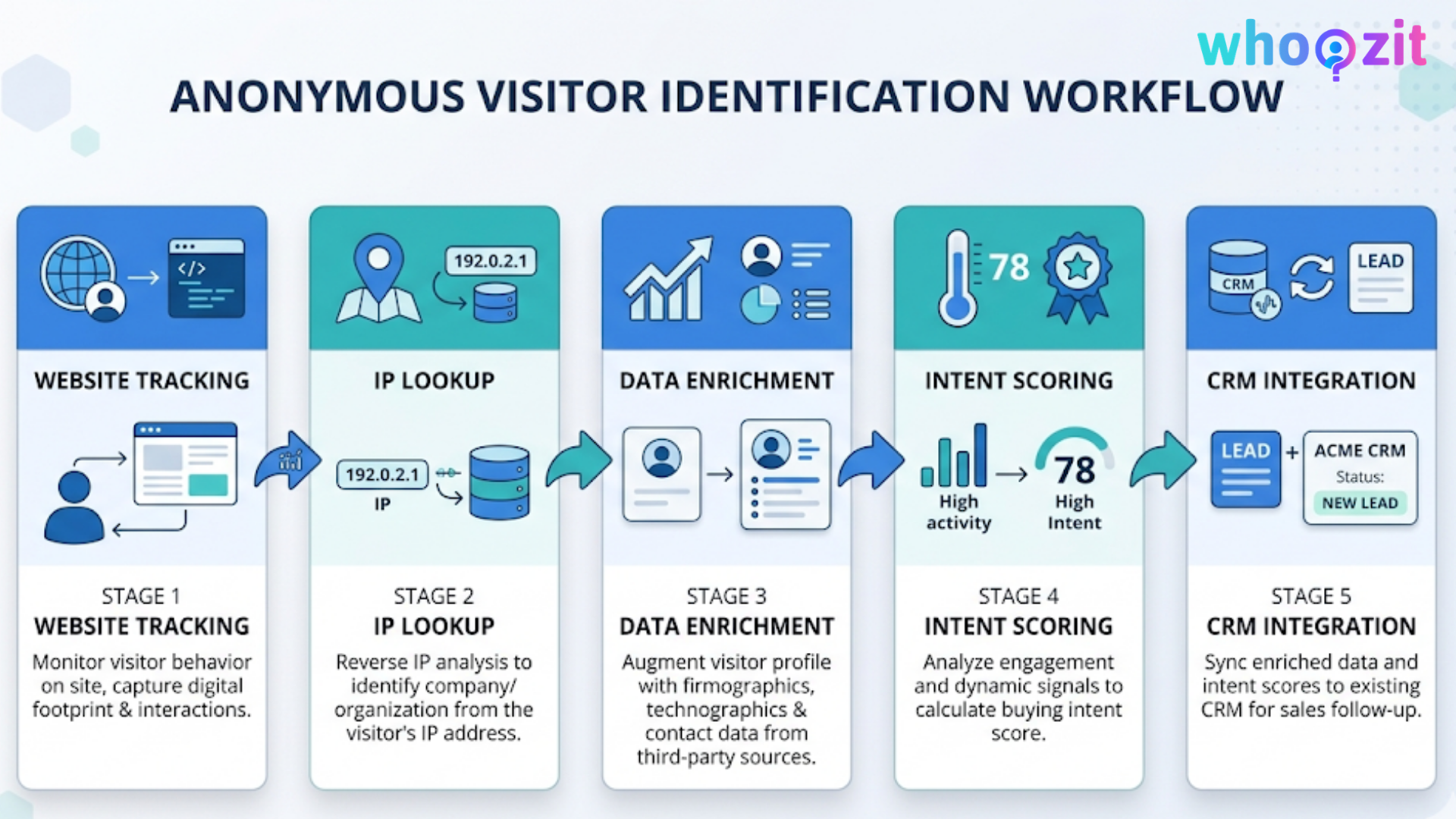
Don’t overcomplicate this. Here is a simple, step-by-step workflow you can implement in a couple of weeks. I’ve used versions of this with marketing teams who needed results fast.
-
Install first-party tracking. Add a lightweight script or server-side event collection to capture page views, URLs, referrers, and timestamps.
-
Capture IPs and do reverse IP lookup. Map the IP to a company name and save it against the session.
-
Score intent. Assign values to pages and events. Build a simple scoring model: pricing page = 40 points, docs = 20, blog = 5.
-
Enrich company data. Add firmographic fields like company size, industry, and tech stack.
-
Route to action. If the intent score crosses a threshold, notify the sales rep, open a chat, or add to an ABM audience.
-
Measure and iterate. Track conversion rates, meetings booked, and pipeline generated. Tweak scoring and thresholds.
These are the practical levers. Start simple and evolve. Avoid building elaborate ML models before getting clean signals into your CRM.
Privacy, compliance, and ethical considerations
Identifying anonymous website visitors is useful, but you have to be careful. Privacy is a real concern and regulators are watching. Here’s what I always recommend.
- Be transparent. Update your privacy policy to explain tracking and enrichment. People notice when you hide things.
- Respect consent. Where required, show cookie banners and offer opt-outs. First-party data collection is stronger when you get consent for analytics.
- Avoid personal data misuse. Focus on account-level signals and avoid trying to identify individuals without consent.
- Use data to help, not to harass. A single helpful outreach is fine. A stream of cold emails is not.
Common compliance frameworks to consider include GDPR and CCPA. If you operate globally, get legal advice early. In my experience, a clear privacy page and conservative data handling will keep your program in good standing and build trust with customers.
Common mistakes and pitfalls
I’ve seen teams stumble in a few recurring ways. Avoid these mistakes and you’ll save time and frustration.
- Over-relying on reverse IP lookup. It’s useful, but not a silver bullet. IPs from cloud providers or mobile networks will mislead you.
- Not validating signals. If a company shows up once for a 10 second visit, don’t flag it as high intent. Use thresholds.
- Poor enrichment quality. Cheap or single-source enrichment can give wrong company sizes or industries. Cross-check sources.
- Ignoring privacy. That creates trust issues and legal risk. Be upfront and conservative with personal data.
- Too many alerts. If sales get flooded with low-quality leads, they’ll ignore the system. Tune thresholds and only notify when signals are meaningful.
Quick wins you can try this week
Want to move fast? Here are simple tactics that usually pay off quickly.
- Set up a basic reverse IP lookup and flag visits to pricing pages. Test it for one week and review the accounts that show up.
- Add a chat widget and configure chat invites for high-intent pages. Keep the initial message short and helpful.
- Create a "visited pricing" audience and run LinkedIn ads to those accounts for two weeks. Track meetings booked.
- Use low-friction content offers like ROI calculators or short video demos that don't require full forms. Use these to capture intent further.
These quick wins often uncover pockets of demand you didn't know you had. I’ve used the pricing-page flag to generate meetings within 48 hours on several occasions.
How to route signals to sales effectively
Generating signals is only half the job. They need to reach the right rep at the right time. Here’s a simple routing framework that works.
- Determine priority tiers. High intent accounts go to a dedicated SDR. Low intent accounts go to marketing nurture.
- Send context with the alert. Include pages viewed, timestamps, intent score, and enrichment data.
- Automate follow-up actions. Create playbooks for SDRs: call, LinkedIn message, demo invite, or wait for a second visit depending on the score.
- Measure response time and conversion. Fast outreach wins. Track meeting rate and pipeline to tune thresholds.
One small operational tip: include the session URL and a short summary in the sales alert. Reps don’t want to parse raw logs. Give them the story.
Measuring success
You should track a few KPIs to know if your anonymous visitor identification program is working.
- Number of identified accounts per week
- Conversion rate from identified account to meeting
- Win rate and deal velocity for identified accounts vs cold outreach
- Pipeline generated from identified accounts
- False positive rate - how often a flagged account turns out to be irrelevant
When I set up programs, I watch conversion rates closely for the first 90 days. It helps you tune scoring and ensures sales trusts the signals.
Real-world examples and simple scripts
Here are two short, practical examples you can relate to. No complex code or ML models. Just basic ideas that work.
Example 1 - Pricing page alert
Scenario: Your pricing page gets a visitor from a corporate IP. You want to alert sales when the same company views pricing more than once within a week.
- Store the IP and page event in your tracking database.
- Resolve the IP to "Acme Corp" using reverse IP lookup.
- If Acme views pricing more than once in seven days, send an email to the assigned SDR with the session summary.
This gets sales in front of active buyers quickly. It’s simple and effective.
Example 2 - ABM list enrichment
Scenario: You have a list of target accounts. You want to know when anyone from those companies visits your site.
- Run a reverse IP lookup against incoming traffic and compare against your ABM list.
- If a match occurs, add the session to a retargeting audience and notify the ABM team.
- Serve personalized landing pages and ads to that account for the next two weeks.
You’ll reach relevant prospects without forcing them to fill out a form.
When to use Whoozit
If this feels like a lot to stitch together, that’s normal. You can build pieces yourself, but it takes time and engineering effort. That’s where a specialized tool helps.
Whoozit focuses on helping B2B teams identify anonymous website visitors and convert them into real pipeline. We combine reverse IP lookup, behavioral tracking, and enrichment so you can identify website visitors by IP and apply intent scoring without complex engineering. If your team wants a ready-made way to do anonymous visitor tracking and website analytics tools that feed into your CRM, Whoozit is built for that workflow.
Helpful detail: Whoozit integrates with common CRMs and ABM platforms so intent signals and company records flow directly to sales. That reduces manual work and speeds up outreach.
Privacy checklist before you launch
Before you flip the switch, run through this checklist. It’s short and will save headaches later.
- Update privacy policy to reflect tracking and enrichment
- Add cookie and consent banners where required
- Document data retention and deletion policies
- Limit access to sensitive data within your team
- Train sales on how to use anonymous signals respectfully
It’s tempting to skip some of these steps to move fast. Don’t. A small amount of setup here prevents big problems later.
FAQs
1. How can I identify anonymous website visitors without using forms?
You can identify anonymous website visitors using techniques like reverse IP lookup, behavioral tracking, cookies, and data enrichment. Tools like Whoozit combine these methods to map visitor activity to company-level insights, helping you engage potential leads without requiring form submissions.
2. Is identifying website visitors by IP accurate?
Identifying visitors by IP can be effective for company-level insights, especially for larger organizations with dedicated IP ranges. However, accuracy may vary due to VPNs, shared networks, or dynamic IPs. Combining IP lookup with behavioral tracking and enrichment improves reliability.
3. What are the best tools for anonymous visitor tracking?
The best tools typically include reverse IP lookup providers, behavioral analytics platforms, enrichment APIs, and ABM tools. Platforms like Whoozit streamline this process by integrating tracking, identification, and intent scoring into one solution.
4. Is anonymous visitor tracking legal and compliant?
Yes, anonymous visitor tracking is legal when done responsibly. Businesses must follow regulations like GDPR and CCPA, be transparent in their privacy policies, obtain consent where required, and focus on company-level data rather than personal identification without permission.
Final thoughts and recommended next steps
If you’re a growth marketer, demand generation leader, or sales professional, identifying anonymous website visitors is one of the highest-leverage moves you can make. It shifts your motion from guesswork to targeted playbooks.
Start simple. Set up reverse IP lookup and basic behavioral scoring. See which accounts light up, validate them manually for a week, then automate routing. Keep privacy in mind and make sure sales treats the signals as helpful context, not magic numbers.
I’ve noticed teams that start with a small, tactical program often scale it into a full ABM motion that consistently generates meetings and shortens deal cycles. It just takes sensible scoring, reliable enrichment, and respectful outreach.